A 48-Hour Layover Itinerary for Lisbon
Lisbon is one of the few European capitals where a layover genuinely earns its keep. The airport sits inside the city rather than out beyond a ring road, so a twenty-minute metro ride puts you at the edge of the Baixa with your bag still on your shoulder. What follows is a two-day plan built around that geography. It assumes you land mid-morning on day one, sleep in the city, and fly out on the evening of day two, and it is timed around the red metro line, Tram 28 and Tram 15 rather than around a checklist of monuments. Screenshot it while you still have airport wifi.
Landing, tickets and the twenty-minute transfer
Follow the Metro signs down from arrivals and you will reach the red line, Linha Vermelha. Ride it to Alameda, change to the green line towards Cais do Sodré, and get off at Baixa-Chiado or Rossio depending on where you are sleeping. Door to door, including the walk and a ticket machine queue, count on thirty-five to forty minutes. The Aerobus is a reasonable alternative if you are carrying more than you can comfortably wheel uphill, and a taxi or ride-hailing car takes fifteen to twenty-five minutes outside rush hour — noticeably longer between eight and ten in the morning.
Three things are worth sorting before you leave the terminal:
- Buy a rechargeable Viva Viagem card from the machine and load it with credit, or add a 24-hour Carris pass if you plan more than three rides in a day. Trams, buses and the funiculars all use the same card.
- Deal with the suitcase. Most hotels will hold bags before check-in. If yours won't, use a left-luggage service rather than dragging a case over cobbles.
- Screenshot the metro map. The metro stops running around one in the morning; night buses keep going, but you don't want to be working that out at a ticket machine at midnight.
Day one, 09:00–13:00: Baixa on foot and down into Alfama
Drop the bag, then walk. Start at Praça do Comércio, the wide river square where the city opens out, and cut through the triumphal arch into Rua Augusta. This is flat, shaded in patches, and gives you a sense of the grid before you start climbing.
By 10:30 head up to the Sé cathedral, then let yourself drift downhill into Alfama. The principle here is simple: start high, walk down. Streets like Rua de São Tomé and the lanes around Largo do Chafariz de Dentro will pull you towards the river without any planning on your part. If fado is on your list for the evening, this is the moment to peer at a few doorways and note names — most fado houses take bookings and fill up.
Stop for coffee and a pastry somewhere with plastic chairs and no menu in English. Around noon, walk east along the waterfront towards Santa Apolónia for twenty minutes and turn back. It is a good stretch for clearing your head after a flight.
Day one, 14:00–19:00: riding Tram 28 without regretting it
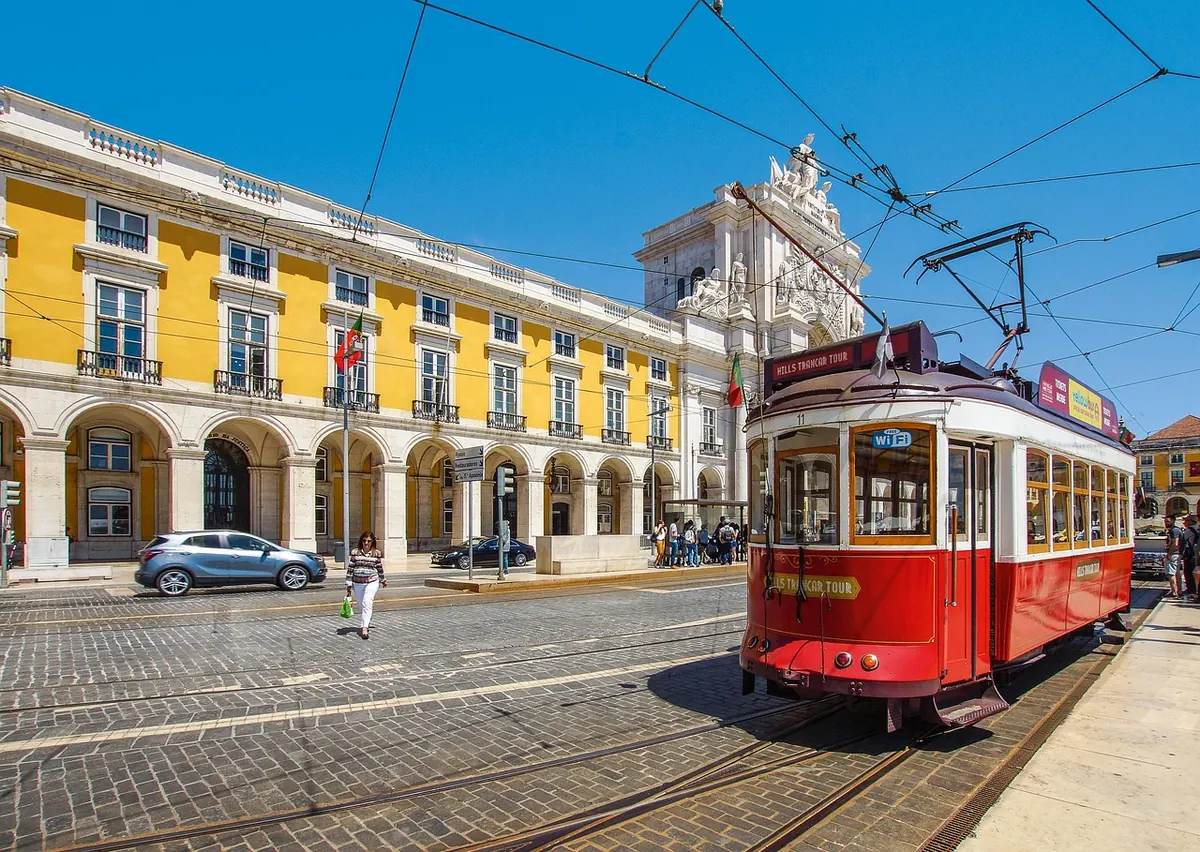
Tram 28 is the city's most famous queue. It runs from Martim Moniz through Graça, past Portas do Sol, down into the Baixa, then up through Chiado, Estrela and on to Campo de Ourique. The whole route takes about forty-five minutes when the traffic behaves, which it often doesn't.
Where to get on
At Martim Moniz you will find a line that can swallow an hour of your afternoon. Two better options: board early, around 14:00, before the tour groups form, or walk up to the Graça stop on Rua da Graça and join a few stops in, where the wait is usually shorter. Tram 12 does a quieter loop through Alfama from the same terminus and is a decent substitute if 28 looks hopeless.
The stretch worth riding
If time is tight, ride from Graça to Chiado and get off. You get the tight corners, the tiled facades at arm's length and the view over the rooftops, without committing your whole afternoon. Keep your phone in a zipped pocket — this route is well known for pickpockets, and the crush near the doors is exactly when it happens.
From Chiado, walk down to Cais do Sodré for a look at the river and the Pink Street, then take the Elevador da Glória up from Restauradores for sunset at São Pedro de Alcântara. Senhora do Monte and Santa Luzia are better viewpoints with fewer people, if you have the legs for one more climb.
Day one, evening: fado, food and the walk downhill
Eat late, as the city does. A fado house in Alfama or Mouraria usually means a set dinner and a fixed performance time, so book in the afternoon rather than turning up hopeful. If you would rather keep it loose, eat at the Time Out Market at Cais do Sodré — many counters, one roof, easy for a tired solo traveller — and find music afterwards in a small bar.
Bairro Alto turns loud after eleven. Sleep there only if you intend to be part of it; otherwise Chiado, Baixa or the Avenidas around Saldanha will give you a quieter night and a quicker morning.
Day two, morning: Belém by Tram 15
Tram 15 leaves from Praça da Figueira and takes roughly twenty minutes to Belém. A faster and far less crowded alternative: catch the Cascais suburban train from Cais do Sodré and get off at Belém, three stops along. Either way, arrive by 09:30 if you want to see the Mosteiro dos Jerónimos without shuffling.
Do the monastery first, then the tower, then loop back along the river past the Padrão dos Descobrimentos. The queue at Pastéis de Belém moves faster than it looks, and eating one warm at the counter is the whole point. Note that the monastery and the tower each close one day a week — Mondays at the time of writing — so check before you build a morning around them.
Day two, afternoon: last loop and the run to the airport
Come back into the centre around 13:00 and keep the afternoon deliberately small. Lunch, one more neighbourhood, a last coffee. The LX Factory, under the bridge in Alcântara, is worth a look on Sundays when its market is on; otherwise the Basílica da Estrela and its garden make a calm final hour.
Then work backwards from your flight:
- 16:00 — final coffee, buy anything you actually need.
- 16:45 — back at the hotel to collect the bag.
- 17:15 — metro from Baixa-Chiado: green to Alameda, change to red, out at Aeroporto. Allow forty minutes with the bag.
- 18:00 — at the terminal for a 20:00 flight. Two hours is the right buffer here; security lines in Lisbon can be slow in summer.
- Before 07:00 — the metro starts around 06:30, so book a taxi the night before rather than gambling.
Practical notes before you book
Pack shoes you can walk uphill in. Lisbon's pavements are polished calçada and they are slick when wet; trainers with grip beat anything stylish. Carry a refillable bottle — there are fountains in the main squares — and shift long walks to the morning in July and August, when the middle of the day is genuinely punishing.
Buy tram and metro tickets as you go rather than in a panic at the barrier, and remember that a 24-hour Carris pass only saves money if you actually use it. Book the Jerónimos monastery and any fado dinner in advance in June, when the Festas de Lisboa fill the city, and in the weeks around Easter. Restaurants, taxi drivers and ticket machines all take cards now, but keep a little cash for the smallest cafés.
The honest summary: this plan covers one walk, two tram rides and a lot of coffee, which is roughly the correct ratio for forty-eight hours in Lisbon. If a viewpoint holds you longer than scheduled, let it. The airport will still be twenty minutes away.
Photo: franky1st / Pixabay